
This post may contain affiliate or referral links, which means I may earn a small bonus if you open an account through one of the links. This comes at no extra cost to you.
When it comes to saving money, many of us grew up hearing the same advice:
“Put some money into your savings account.”
But what most of us weren’t taught is that not all savings accounts work the same way.
A high yield savings account (HYSA) is a savings account that offers a much higher interest rate than a traditional savings account. That means your money can earn more money simply by sitting in the account.
While many traditional savings accounts earn around 0.01% interest, high yield savings accounts often offer 3–5% or more, which can help your money grow faster over time.
That difference might not sound huge at first, but it can add up quickly.
For example, if you had $10,000 in savings, a traditional account might earn you about $1 in interest for the year, while a high yield savings account could earn $300–$500 instead.
It won’t make you rich overnight, but it’s definitely better than earning just a dollar or two in interest after an entire year.
If you’re trying to be smarter with your savings, switching to a high yield savings account is one of the simplest things you can do.
In this guide, you’ll learn what a high yield savings account is, how it works, how it compares to a regular savings account, some of the best options available, and how to open one.
What Is a High Yield Savings Account?
A high yield savings account (HYSA) is a type of savings account that pays a higher interest rate than a traditional savings account.
Because the interest rate is higher, the money you deposit can grow faster over time, even if you are not regularly adding more money to the account. High yield savings accounts can often earn 10 times or more the interest of a traditional savings account.
Most high yield savings accounts are offered by online banks, which often have lower operating costs than traditional banks. Because they don’t need to maintain as many physical branch locations, they can often pass those savings on to customers through higher interest rates.
Interest on savings accounts is usually shown as APY, which stands for Annual Percentage Yield. APY tells you how much interest your money can earn in a year, including the effect of compounding.
For example, if a savings account offers 3.5% APY, your savings could grow by about 3.5% over the course of a year, assuming the interest rate stays the same.
High Yield Savings Account vs Regular Savings Account
Both types of accounts help you save money, but there are a few important differences between a high yield savings account and a regular savings account.
The biggest difference is the interest rate, which determines how much your savings can grow over time.
Here’s a simple comparison:
| Feature | Regular Savings Account | High Yield Savings Account |
| Interest rate | Around 0.01% | Often ~3–5% |
| Where they’re offered | Traditional banks | Mostly online banks |
| Money growth | Very slow | Faster growth |
| Access to money | Easy. Instant transfers, ATM withdrawals, or branch access | Easy. Usually transferred online; may take 1–3 business days |
| FDIC Insured | Usually FDIC insured up to $250,000 per bank | Usually FDIC insured up to $250,000 per bank |
| Risk | Low Risk | Low risk |
As you can see, high yield savings accounts work very similarly to traditional savings accounts. You can still transfer money in and out, check your balance, and move funds when needed.
Most high yield savings accounts are also FDIC insured, meaning deposits are typically protected up to $250,000 per depositor, per bank. This gives many savers additional peace of mind.
One small difference is that transfers may take 1–3 business days, since many high yield savings accounts are offered by online banks. For many people, that short wait is worth it for the higher interest their savings can earn.
How Much Can You Earn in a High Yield Savings Account?
The difference between a traditional savings account and a high yield savings account becomes much clearer when you look at a simple example.
Let’s say you have $10,000 in savings.
Here’s how much that money could earn in each type of account.
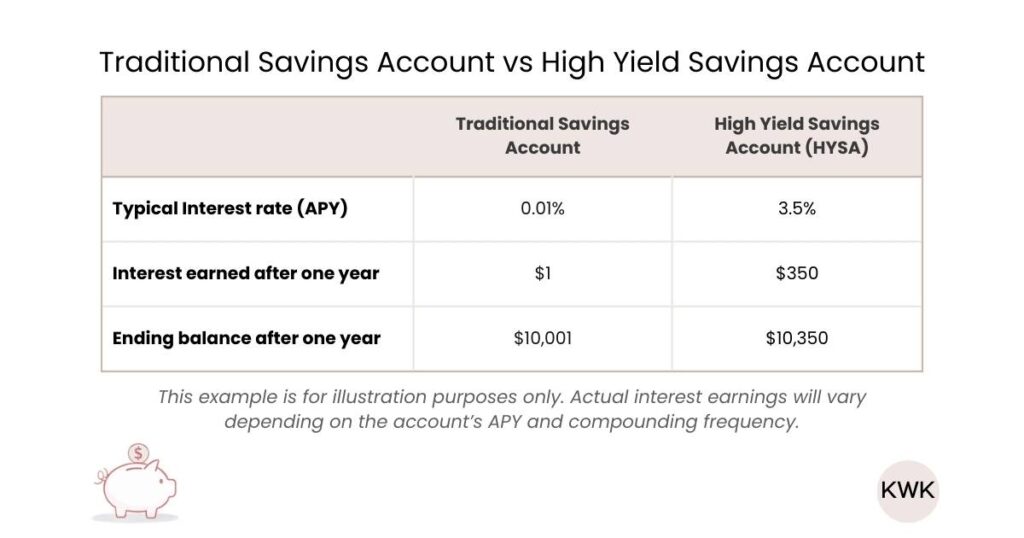
And that’s without adding any additional money during the year.
That’s a difference of hundreds of dollars per year, simply from keeping your savings in an account with a higher interest rate. Even small differences in interest rates can add up over time.
Those extra earnings can help you reach your savings goal faster, cover an unexpected expense, or go toward something you’ve been saving for. If you leave the money in the account, it can also continue earning interest over time.
This is one of the reasons high yield savings accounts have become so popular. Many people realized their savings could work a little harder without doing anything complicated.
When Should You Use a High Yield Savings Account?
A high yield savings account works best for short-term savings goals. It’s designed for money you want to keep safe and accessible while still earning some interest.
Unlike investing, where money usually stays invested for many years, these accounts work better for funds you may need sooner.
Here are a few common situations where people use this type of savings account.
Emergency fund
One of the most common uses for an HYSA is an emergency fund. Because the money stays accessible and continues earning interest, it can be a good place to keep funds for unexpected expenses like medical bills, car repairs, or a sudden job loss.
Sinking funds
Many people also use HYSAs for sinking funds, which are savings set aside for planned future expenses. Examples might include holiday spending, an upcoming vacation, a wedding fund, annual insurance payments, or home maintenance.
Money You May Need in the Near Future
If you expect to use the money in the near future, a high yield savings account can be a simple place to keep it while still earning some interest.
HYSAs work best for short-term savings, not long-term investing.
For long-term wealth building, accounts like retirement accounts or brokerage accounts typically offer more growth over time.
Pros and Cons of High Yield Savings Accounts
Like any financial account, high yield savings accounts come with both advantages and a few tradeoffs.
Pros
- Higher interest rates than traditional savings accounts, which helps your savings grow faster
- Low risk, especially when the account is FDIC insured
- Money stays accessible while still earning interest
- Simple to open and manage, often entirely online
- Good option for short-term savings goals, like emergency funds or sinking funds
Cons
- Interest rates can change depending on overall economic conditions
- Transfers may take 1 to 3 business days, depending on the bank
- Lower long-term growth potential compared to investing
- Some accounts may have withdrawal limits or transfer restrictions
- Some accounts do not offer ATM access
Overall, high yield savings accounts can be a simple and low-risk way to help your savings grow faster while still keeping your money accessible.
If you decide a high yield savings account fits your financial goals, the next step is learning how to open one.
How to Open a High Yield Savings Account
Opening a high yield savings account is usually quick and often takes just a few minutes. Most banks allow you to open an account through their website or mobile app.
Here are the basic steps.
1. Compare banks and interest rates
Start by looking at banks that offer high yield savings accounts and compare their current interest rates, fees, and account requirements.
Pay attention to things like monthly fees, minimum balance requirements, and how easy it is to transfer money in and out of the account, since these features can affect how convenient the account is to use.
2. Choose a bank and start the application
Once you choose a bank, you can begin the application online. Most banks will ask for basic information such as your name, address, Social Security number (SSN) or Individual Taxpayer Identification Number (ITIN), and identification.
Banks use this information to verify your identity and set up your account.
3. Link your checking account
After opening the account, you’ll usually connect it to an existing checking account so you can transfer money into your new savings account.
4. Make your first deposit
Transfer money into the account to begin earning interest.
5. (Optional) Automate your savings
Many banks also allow you to set up automatic transfers from your checking account to your savings account during setup. You can choose how often the transfer happens, such as biweekly or monthly.
This can make it easier to consistently add to your savings for things like an emergency fund or sinking funds, without having to remember to transfer money manually.
Once your account is set up and funded, your savings will begin earning interest based on the account’s APY (Annual Percentage Yield). Depending on the bank, verifying your information and linking your checking account may take one to a few business days before transfers are fully active.
Best High Yield Savings Accounts (HYSAs)
Rates mentioned in this section were last reviewed in March 2026 and may change over time.
Many online banks and financial institutions offer high-interest savings accounts, but the interest rates can change over time.
Banks often adjust their savings rates based on changes in overall interest rates and economic conditions, so it’s a good idea to compare a few options before opening an account.
While APY (Annual Percentage Yield) is important, it shouldn’t be the only factor to consider when choosing a high yield savings account.
When comparing accounts, it can also help to look at things like:
- whether the account has monthly fees
- minimum balance requirements
- how easy it is to transfer money in and out of the account
- whether the bank is FDIC insured
- whether the bank has a user-friendly mobile app or online dashboard
The following banks are well-known online institutions that offer competitive high yield savings accounts and are popular among savers. Some of them are accounts I personally use as well.
Ally Bank
Ally Bank offers a high yield savings account with competitive interest rates and no monthly maintenance fees. Ally also offers “savings buckets,” which allow you to divide your savings into different categories within the same account.
I personally use Ally Bank for my sinking funds, since the bucket feature makes it easy to organize different savings goals in one place. Ally also offers flexible automatic transfer frequencies, making it easier to schedule contributions based on your paycheck schedule.
- APY: Around 3.20% (as of March 2026)
- Fees: No monthly maintenance fees
If you’re interested, you can learn more about the Ally High Yield Savings Account.
Marcus by Goldman Sachs
Marcus by Goldman Sachs offers a high yield online savings account with competitive interest rates and no monthly fees.
I personally use Marcus to hold my emergency fund, since I prefer keeping that money separate from my other savings goals.
In my experience, transfers are often faster than expected for a high yield savings account. If you initiate a transfer earlier in the business day, the funds often arrive the next business day.
- APY: Around 3.65% (as of March 2026)
- Fees: No monthly maintenance fees
If you’re interested, you can learn more about the Marcus High Yield Online Savings Account.
Capital One 360 Performance Savings
The Capital One 360 Performance Savings account is a high yield savings option with no monthly fees and no minimum balance requirements. It can be a convenient option if you already bank with Capital One or prefer a bank that has both online banking and physical locations.
You can also get in-person help at Capital One branches or Capital One Cafés, which many online-only banks don’t offer.
- APY: Around 3.60% (as of April 2025)
- Fees: No monthly maintenance fees
SoFi Savings
The SoFi Savings account is part of SoFi’s broader online banking platform and offers a high yield savings option with no monthly fees and no minimum balance requirements. It can be a convenient option if you already use SoFi for other financial services like investing, lending, or student loan refinancing.
SoFi also offers “Savings Vaults,” which allow you to divide your savings into separate categories for different goals.
You can also automatically contribute to these Vaults through direct deposit or debit card roundups, making it easier to consistently add to your savings.
- APY: Up to 3.30% (as of March 2026) depending on direct deposit activity
- Fees: No monthly maintenance fees
Frequently asked questions
Are High Yield Savings Accounts Safe?
Yes, high yield savings accounts are generally very safe as long as they come from an FDIC-insured bank. FDIC insurance typically protects deposits up to $250,000 per depositor, per bank, even if the bank fails.
Before opening an account, it’s always a good idea to confirm that the bank is FDIC insured.
Can you lose money in a high yield savings account?
High yield savings accounts do not fluctuate with the stock market, so your balance does not go up and down like investments.
As long as the account is FDIC insured, deposits are typically protected up to the coverage limits. However, interest rates can change over time, which may affect how much interest your savings earn.
How much money should you keep in a high yield savings account?
The amount you keep in a high yield savings account depends on your financial goals. Many people use these accounts for emergency funds, sinking funds, or other short-term savings.
A common recommendation is to keep 3 to 6 months of living expenses in an emergency fund so the money stays accessible while still earning interest.
Final Thoughts
A high yield savings account can be a simple way to earn more interest on money you’re already saving.
While traditional savings accounts are what many of us grew up hearing about, high yield savings accounts can help your money grow faster while still keeping it safe and accessible.
They’re often a practical place to keep emergency funds, sinking funds, or other short-term savings while still earning interest.
If your savings are currently sitting in a traditional account earning very little interest, it may be worth exploring a few high yield savings options and comparing banks.
In my experience, switching to a HYSA was one of the first “money upgrades” I made, and it was surprisingly easy, especially since personal finance wasn’t something I learned much about growing up.
If you take a few minutes to choose the right account, that small step can help your money grow over time with very little extra effort.